
Michigan License Renewal at 70: Vision Rules and Insurance Impact
Free to compare
Does Michigan require a vision test when you renew your driver's license at age 70?
Michigan does not require vision testing at age 70 renewal. The state eliminated mandatory vision screening for older drivers in routine renewals — you renew online or by mail using the same process you've used for decades. Vision tests are only required if the Secretary of State receives a medical report from law enforcement, a physician, or a family member questioning your visual capacity to drive safely.
This puts Michigan in a small minority of states. Most states institute vision screening requirements between ages 64 and 75, often paired with in-person renewal mandates. Michigan allows online renewal through age 75 with no additional requirements beyond standard identity verification and fee payment.
The absence of state-mandated testing does not prevent your insurance carrier from adjusting your premium at age 70. Carriers price policies using age brackets, and 70 is a common threshold where rates begin climbing regardless of your driving record or medical status. The state's renewal process hasn't changed, but your actuarial risk category has.
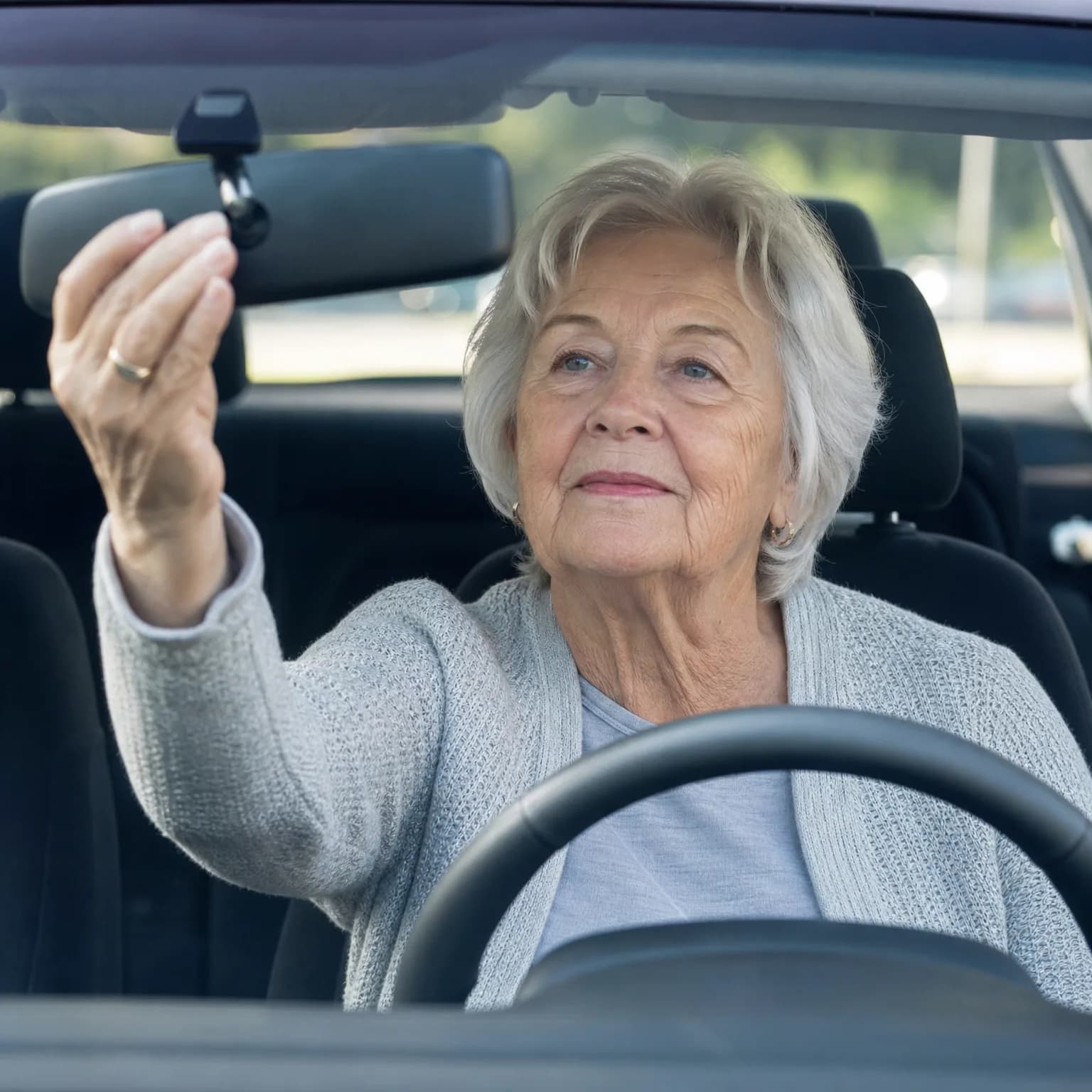
What actually changes at your Michigan license renewal when you turn 70?
Your renewal cycle remains four years through age 75. You renew online through the Michigan Secretary of State portal, pay the standard $18 fee, and receive your license by mail within 14 business days. No vision test, no road test, no in-person visit required unless the state has received a specific medical referral about your driving ability.
Starting at age 75, Michigan shifts to in-person renewal only. You must visit a Secretary of State branch office, complete a vision screening at that time, and renew in person every four years thereafter. The vision standard is 20/40 in at least one eye with or without corrective lenses — the same threshold the state uses for all drivers.
Between ages 70 and 74, the only change most drivers notice is on their insurance bill. Carriers reprice your policy based on age bracket transition, not on any new state requirement or documented change in your driving ability. You are statistically grouped with drivers who have higher claim frequencies, even if your individual record has been clean for 30 years.


Why does your insurance rate increase at 70 if Michigan doesn't require additional testing?
Insurance carriers price policies using actuarial age bands. Age 70 marks a common threshold where claim frequency data shows increased risk across the driver population — not because of your individual record, but because of aggregate statistics for drivers in that age group. Carriers apply this pricing adjustment automatically at renewal, regardless of whether your state mandates additional licensing requirements.
Michigan's lack of vision testing at 70 does not shield you from carrier repricing. The rate increase is driven by national actuarial tables, not state regulatory changes. Typical increases range from 8% to 18% between ages 65 and 75, with the steepest jumps occurring at ages 70 and 75 when carriers move you into new rating tiers.
This creates a disconnect many senior drivers find frustrating: the state confirms you are fit to drive with no additional testing, but your carrier raises your rate as if your risk profile changed overnight. The carrier is pricing future claim probability across all 70-year-old drivers, not evaluating your specific driving history or health status.
See What Drivers Over 65 Are Paying Now
See If You Qualify for DiscountsWhat discounts offset age-based rate increases for Michigan drivers over 70?
Mature driver course discounts remain the most underutilized tool for Michigan seniors. State law does not mandate this discount, but most major carriers operating in Michigan offer 5% to 10% premium reductions for drivers who complete an approved defensive driving course. AARP Smart Driver and AAA Driver Improvement courses qualify with most carriers and can be completed online in 4 to 6 hours. The discount typically applies for three years, then requires course re-completion.
Low-mileage programs become cost-justified once you stop commuting. If you drive fewer than 7,500 miles annually, carriers including State Farm, Allstate, and Nationwide offer mileage-based discounts ranging from 10% to 20%. Some require odometer verification at renewal; others use telematics devices that also track hard braking and speed, which may work against you if you drive cautiously but brake firmly to compensate for slower reaction time.
Multi-policy bundling delivers 15% to 25% savings when you combine auto and homeowners coverage with the same carrier. If you've been with the same auto insurer for decades but carry home insurance elsewhere, consolidating policies often offsets the age-based rate increase entirely. Loyalty discounts for long-term customers apply inconsistently — some carriers reward tenure with 5% to 10% reductions, while others raise rates on long-standing customers assuming they won't shop around.

Should you reduce coverage when your vehicle is paid off and you drive less?
Dropping collision coverage makes financial sense when your vehicle's actual cash value falls below $3,000 and you have savings to replace it outright if totaled. Collision premiums on older vehicles often run $400 to $700 annually — if your car is worth $2,500, you are paying insurance premiums that exceed potential claim payout within four years. Carriers pay actual cash value at the time of loss, not replacement cost, so you recover depreciated value minus your deductible.
Comprehensive coverage costs less than collision and protects against theft, weather damage, and animal strikes. In Michigan, where deer collisions remain common in suburban and rural counties, keeping comprehensive coverage often justifies the $150 to $300 annual cost even on a paid-off vehicle. Comprehensive claims do not typically raise your rate the way at-fault collision claims do.
Liability coverage should never be reduced regardless of your vehicle's value. Michigan requires $50,000 per person and $100,000 per accident in bodily injury liability, but this minimum leaves you personally exposed if you cause a serious accident. Medical costs from a single severe injury easily exceed $100,000, and you remain personally liable for damages beyond your policy limits. Carriers offer $250,000/$500,000 liability limits for an additional $80 to $150 annually — a fraction of the financial exposure you carry with state minimums.

How does Medicare interact with Michigan auto insurance after age 65?
Michigan operates as a no-fault state, meaning your own auto insurance pays your medical bills after an accident regardless of who caused the crash. Personal Injury Protection (PIP) coverage is primary — it pays before Medicare, even though you are enrolled in Medicare. Michigan recently restructured PIP to allow coverage limit selection: unlimited medical, $500,000, $250,000, $100,000, or PIP opt-out if you have qualified health insurance.
Medicare does not cover auto accident injuries when PIP coverage applies. If you carry PIP, your auto insurer pays first and Medicare is never billed. If you opted out of PIP entirely because you have Medicare, you have likely made a costly mistake — Medicare becomes primary for accident injuries, but Medicare does not cover all accident-related costs, leaves you with copays and deductibles, and does not cover long-term attendant care that Michigan PIP historically provided.
Drivers over 65 often reduce PIP limits to $100,000 or $250,000 to lower premiums, assuming Medicare will fill the gap. This works only if your accident injuries fall within that PIP cap and resolve within standard Medicare coverage parameters. Severe injuries requiring extended rehabilitation or in-home care exceed these limits quickly, and Medicare does not provide the unlimited lifetime coverage that Michigan's legacy no-fault system once guaranteed. Review your PIP selection annually — the premium savings from dropping to minimum PIP may not justify the coverage gap if you are seriously injured.
Frequently Asked Questions
Does AARP offer car insurance discounts in Michigan for drivers over 70?
AARP does not sell auto insurance directly but endorses The Hartford, which offers members a discount and recertification-free renewal in some cases. The Hartford's AARP program includes accident forgiveness and new car replacement, but rates for drivers over 70 are often higher than State Farm or Auto-Owners even with the AARP discount applied. Compare the AARP Hartford rate against standard carriers with mature driver course discounts before assuming the affinity program delivers the best price.
Can my adult child request that Michigan require me to take a vision test or road test?
Yes. Any person can submit a Request for Driver Evaluation (form RI-56) to the Michigan Secretary of State expressing concern about a driver's ability. The state reviews the request and may require vision screening, medical documentation, or a road test depending on the specific concerns raised. This process is confidential — the state does not disclose who submitted the request to the driver being evaluated.
Will my insurance rate go back down after age 75 if I pass the vision test and in-person renewal?
No. Passing Michigan's age-75 vision screening and in-person renewal does not reduce your insurance premium. Rates typically continue increasing after 75 as you move into higher-risk age brackets, with particularly steep increases after age 80. The state's licensing requirements and insurance carrier pricing operate independently — meeting state standards does not change actuarial risk classification.
What happens to my Michigan license if I fail the vision test at age 75 renewal?
If you do not meet the 20/40 vision standard in at least one eye, Michigan requires you to submit a Vision Examination Report (form RI-98) completed by an optometrist or ophthalmologist. If corrective lenses bring your vision to 20/40 or better, your license is renewed with a corrective lenses restriction. If vision cannot be corrected to 20/40, the state may restrict your license to daytime driving only or deny renewal depending on the degree of impairment.
Related Articles

MI License Renewal at 75: Tests, Rates, and Discounts
4/29/2026

Michigan Vision Test for Seniors: License Renewal Guide
4/29/2026

Michigan License Renewal at 80: Test Requirements
4/29/2026

Michigan License Renewal at 85: Testing & Insurance
4/29/2026

MA License Renewal at 70: Vision, Tests & Insurance
4/29/2026

Maryland License Renewal at 70: Vision & Insurance
4/29/2026