
License Renewal at 85 in Michigan: What to Expect and Prepare For
Free to compare
What Michigan Requires at Age 85 Renewal
Michigan requires in-person renewal at every license cycle once you turn 85, with mandatory vision testing at the Secretary of State office. You cannot renew online or by mail after this age. The vision test requires 20/40 acuity in at least one eye, with or without corrective lenses.
Road testing is not automatic at 85, but Secretary of State staff have discretion to require one if they observe mobility issues, confusion during the transaction, or concerning responses during the application process. Family members, physicians, or law enforcement can also file a driver evaluation request that triggers mandatory reexamination.
Your renewal notice will specify your in-person appointment requirement 45 days before expiration. Michigan allows a grace period, but driving on an expired license — even by one day — creates liability coverage gaps that most carriers will not backdate to cover.

How to Prepare for In-Person Renewal
Schedule your appointment as soon as you receive the notice, especially between October and March when Michigan Secretary of State offices see highest senior renewal volume. Bring your current license, proof of Social Security number, and two documents proving Michigan residency if you've moved since your last renewal.
If you wear glasses or contacts for driving, bring them and a backup pair. The vision test uses a standard eye chart at a fixed distance. If you fail the initial screening, you'll be referred for a professional eye exam, and your license will not renew until you return with a completed Vision Examination Report form from an optometrist or ophthalmologist.
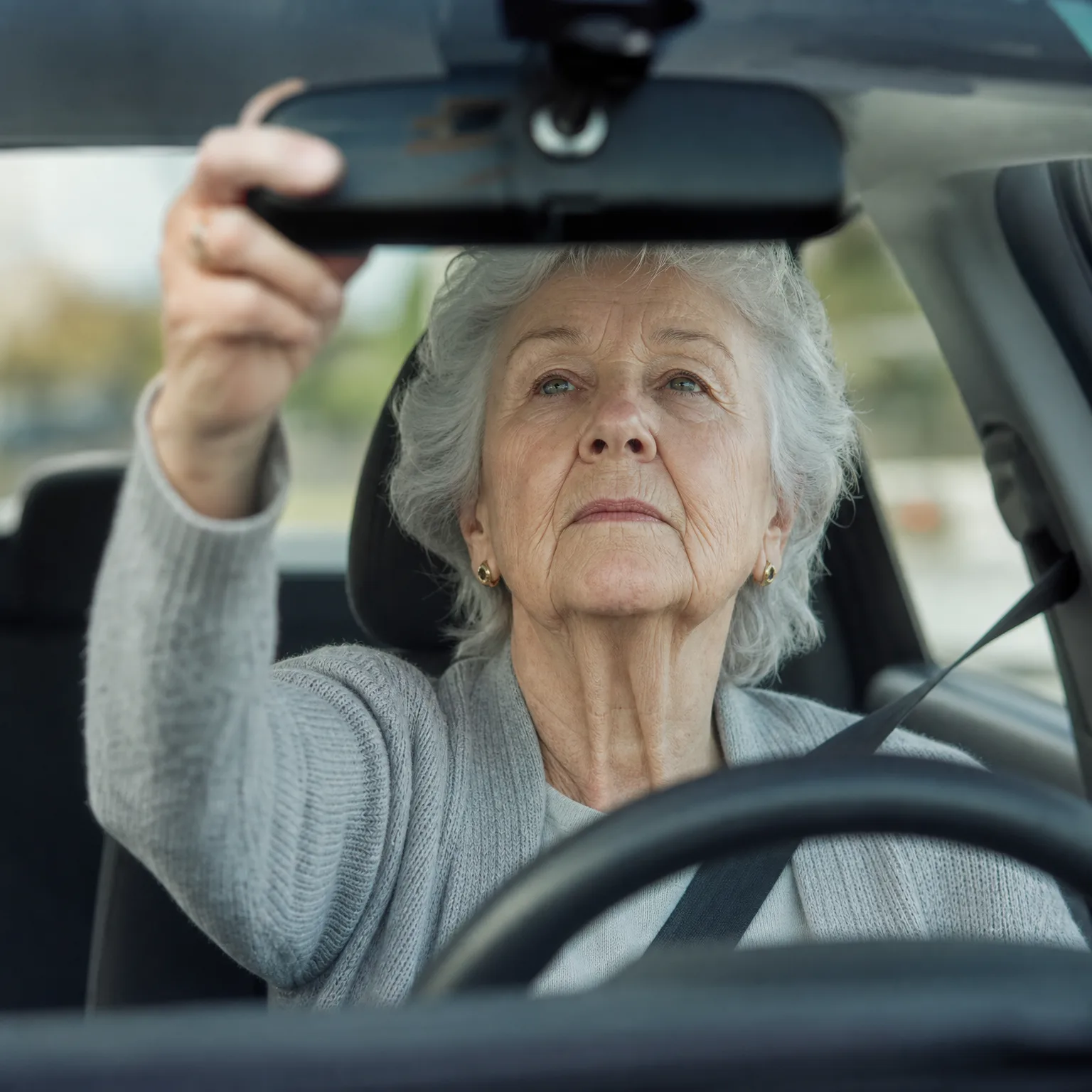
If staff request a road test, it covers basic maneuvers: lane changes, turns, backing, parking, and intersection navigation. You'll use your own vehicle. Automatic failure triggers include failure to yield, unsafe lane changes, or inability to maintain lane position. You can retest after 14 days if you fail, but each failed attempt appears in your driving record abstract.
What Happens If You're Required to Take a Road Test
Secretary of State examiners evaluate steering control, speed regulation, lane discipline, and situational awareness. The test takes 15-20 minutes and covers residential streets, a higher-speed road if available nearby, and parking maneuvers. Most 85-year-old drivers pass on the first attempt if they've been driving regularly.
If you fail, you receive a detailed report identifying specific deficiencies. You can schedule a retest after 14 days, with no limit on attempts within the one-year evaluation period. Some drivers use the interim period to take refresher lessons with a certified driving instructor — this is not required, but documented training can help if multiple attempts are needed.
Failing a road test does not automatically revoke your license. You remain licensed to drive until the one-year evaluation period expires or until you exhaust retests without passing. However, even passing after a required retest creates an insurance issue most drivers don't anticipate.
How License Retesting Affects Insurance Rates
Carriers receive notification when a road test is administered, even if you pass. Most increase premiums 15-25% at the next renewal after any documented reexamination for drivers over 80, treating the test requirement itself as a risk signal regardless of outcome. This pricing behavior is not regulated by Michigan's Department of Insurance and Financial Services, and carriers are not required to disclose the rate factor separately on your policy documents.
The increase persists for 3-5 years depending on carrier, functionally identical to how a minor violation is surcharged. If you're currently paying $95/month for full coverage, expect that to rise to $110-120/month after a documented road retest, even with a clean pass and no accidents.
Some carriers offer mature driver course discounts that partially offset retest surcharges. AARP and AAA offer state-approved courses that qualify for 5-10% discounts in Michigan, renewable every three years. The course costs $20-30 and takes 4-6 hours online or in-person, and the discount applies for three full policy terms if you complete it before the retest notation appears in your record.

See What Drivers Over 65 Are Paying Now
See If You Qualify for Discounts
When Family Members Should Get Involved
Adult children often notice driving changes before the driver does: difficulty with left turns across traffic, slower reaction times, confusion in unfamiliar areas, or close calls in parking lots. Michigan allows family members to file a confidential Request for Driver Reexamination with the Secretary of State, but this triggers mandatory testing and creates family conflict in many cases.
A better first step: ride together and observe specific behaviors rather than making blanket assessments. If you notice consistent issues, suggest a voluntary driving evaluation with an occupational therapist certified in driver rehabilitation. Michigan has 12 certified programs statewide. The evaluation costs $300-450, is not covered by Medicare, but produces an objective third-party assessment and often identifies correctable issues like medication side effects or vision problems.
If the evaluation recommends restrictions — daylight only, no freeway, local radius limits — you can voluntarily adopt those without state involvement. However, if you later cause an accident outside those self-imposed limits, liability coverage may be challenged. Documenting the restrictions with your carrier in writing avoids that gap.

Coverage Adjustments That Make Sense at 85
Most 85-year-old Michigan drivers own paid-off vehicles worth $8,000-15,000 and drive 4,000-6,000 miles annually. Full coverage costs $140-190/month in this profile, while state minimum liability costs $50-70/month. The decision point: is comprehensive and collision coverage worth $90-120/month to protect an aging asset?
If your vehicle is worth less than $5,000, dropping collision makes sense in most cases. Comprehensive remains cost-justified for theft, weather, and animal strikes even on older vehicles — it typically costs $15-25/month as a standalone addition to liability. Collision costs $60-90/month and pays only after your deductible, usually $500-1,000.
Medical payments coverage overlaps with Medicare Part B but pays immediately without deductible for accident-related injuries, while Medicare involves copays and deductibles. Adding $5,000 in medical payments costs $8-12/month and covers passengers who may not have Medicare. Uninsured motorist coverage is essential — 20% of Michigan drivers carry no insurance despite the state mandate, and UM coverage is your only financial protection if one hits you.
How to Handle the Insurance Conversation With Your Carrier
Request a policy review 60-90 days before your license renewal appointment. Ask specifically about mature driver discounts, low-mileage programs, and telematics options. State your current annual mileage — many 85-year-old drivers qualify for low-mileage discounts at under 7,500 miles per year but never ask and carriers rarely apply them automatically.
If your carrier increases your rate after renewal without explanation, request a detailed breakdown in writing. Michigan requires carriers to disclose rating factors on request. If the increase stems from the in-person renewal or a road test notation, ask whether completing a state-approved mature driver course will offset it.
Compare rates annually regardless of your renewal outcome. Carriers price senior risk differently — some penalize age heavily after 80, others weight driving record and claims history more than age. Three identical profiles can receive quotes varying by $400-700 annually. Shopping doesn't affect your current coverage and takes 20-30 minutes with basic policy information in hand.
Frequently Asked Questions
Can I renew my Michigan license online at age 85?
No. Michigan requires in-person renewal at every cycle once you turn 85, with mandatory vision testing at a Secretary of State office. Online and mail renewal are not available after this age, regardless of your driving record or vision history.
Does Michigan automatically require a road test at 85?
Road testing is not automatic at 85, but Secretary of State staff have discretion to require one based on observed mobility issues, confusion during your transaction, or requests from family members or physicians. Most drivers complete only the vision test unless specific concerns arise.
Will my car insurance go up after in-person license renewal?
Rates typically increase 15-25% if a road test is administered, even if you pass. Carriers treat the test requirement as a risk signal and apply surcharges similar to minor violations, persisting for 3-5 years depending on the carrier.
What vision standard does Michigan require at 85?
Michigan requires 20/40 acuity in at least one eye, with or without corrective lenses. If you fail the initial screening, you'll need a professional eye exam and a completed Vision Examination Report before your license renews.
Should I keep full coverage on my paid-off car at 85?
If your vehicle is worth less than $5,000, dropping collision usually makes sense. Comprehensive remains cost-justified even on older vehicles for theft and weather damage at $15-25/month. Liability and uninsured motorist coverage should always be maintained regardless of vehicle value.
Related Articles
Michigan License Renewal at 80: Test Requirements
4/29/2026

Michigan Vision Test for Seniors: License Renewal Guide
4/29/2026

MI License Renewal at 75: Tests, Rates, and Discounts
4/29/2026
Michigan License Renewal at 70: Vision & Insurance Facts
4/29/2026
License Renewal at 85 in MA: Testing & Insurance
4/29/2026
MN License Renewal at 85: Testing & Insurance Changes
4/29/2026